
Trwa ładowanie strony..
Informacje o produkcie


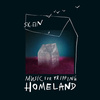
At the heart of the album lie fragments of lo-fi cassette recordings captured between 1997 and 2001 in a modest apartment high above the rooftops of Minsk. Originally recorded with borrowed instruments and a Vega tape deck, these sketches were acts of teenage escapism – imagining misty forests, vanished villages, forgotten roads. Two decades later, SK.EIN returns to them not with nostalgia, but with the curiosity and clarity of distance. As he puts it: “Back then, music was my only way to travel. In this sense, the album is a recycling of my earliest musical experiences – a way to keep the journey going.”
Music for Tripping Homeland plays like a map drawn from memory – each track named after a real road, yet leading into dreamlike terrain. Musically, it's a natural progression from SK.EIN's previous works, where electronica meets folk, post-rock, and ambient, while utilizing field recordings. Some pieces are spacious and light, with ambient textures, hazy guitars, and gentle loops reminiscent of July Skies, early Sigur Rós, or Bibio’s Phantom Brickworks. Others move toward darker, more fragmented territory: rural field recordings dissolve into static, drum machines falter under layers of tape hiss, melodies fray at the edges. There’s a fragile, hand-crafted quality to the album that suggests both intimacy and resilience – like a home that still stands in the shadow of the frontline.
While the sound is rooted in the artist’s homeland, its meaning resonates far beyond borders. These aren’t tracks about national identity or belonging – they are reflections on place, time, and personal history. A quiet form of endurance runs beneath it all: shaped not by slogans, but by lived experience, by care for one’s surroundings, by the simple act of returning to an old sound and choosing to carry it forward.
The album opens with E30 – named after the main east-west road running through the region – with SK.EIN’s voice repeating a short lyric in Belarusian: “Home will swallow me, and you – the foreign land.” It sets a tone of quiet ambivalence, of drifting between staying and leaving, of finding meaning in the spaces in between.
In Music for Tripping Homeland, travel becomes a metaphor: for transformation, memory, and the ways we inhabit the world when movement is limited. It’s a personal and deeply poetic work – not loud, but lasting.
Each title on Music for Tripping Homeland refers to a real road – highways and dirt paths that cut across the artist’s native terrain. But they are more than coordinates: they are emotional landmarks, memory triggers, portals into imagined landscapes. These numbered routes – E30, P128, H9758 – sketch a personal cartography of places both visited and dreamed. Together, they form a quiet manifesto of persistence, a portrait of someone who chose to stay – not out of resignation, but out of a need to remain rooted in what shaped them. A place both real and imagined – one that shelters without isolating, and resists without shouting.
Music for Tripping Homeland plays like a map drawn from memory – each track named after a real road, yet leading into dreamlike terrain. Musically, it's a natural progression from SK.EIN's previous works, where electronica meets folk, post-rock, and ambient, while utilizing field recordings. Some pieces are spacious and light, with ambient textures, hazy guitars, and gentle loops reminiscent of July Skies, early Sigur Rós, or Bibio’s Phantom Brickworks. Others move toward darker, more fragmented territory: rural field recordings dissolve into static, drum machines falter under layers of tape hiss, melodies fray at the edges. There’s a fragile, hand-crafted quality to the album that suggests both intimacy and resilience – like a home that still stands in the shadow of the frontline.
While the sound is rooted in the artist’s homeland, its meaning resonates far beyond borders. These aren’t tracks about national identity or belonging – they are reflections on place, time, and personal history. A quiet form of endurance runs beneath it all: shaped not by slogans, but by lived experience, by care for one’s surroundings, by the simple act of returning to an old sound and choosing to carry it forward.
The album opens with E30 – named after the main east-west road running through the region – with SK.EIN’s voice repeating a short lyric in Belarusian: “Home will swallow me, and you – the foreign land.” It sets a tone of quiet ambivalence, of drifting between staying and leaving, of finding meaning in the spaces in between.
In Music for Tripping Homeland, travel becomes a metaphor: for transformation, memory, and the ways we inhabit the world when movement is limited. It’s a personal and deeply poetic work – not loud, but lasting.
Each title on Music for Tripping Homeland refers to a real road – highways and dirt paths that cut across the artist’s native terrain. But they are more than coordinates: they are emotional landmarks, memory triggers, portals into imagined landscapes. These numbered routes – E30, P128, H9758 – sketch a personal cartography of places both visited and dreamed. Together, they form a quiet manifesto of persistence, a portrait of someone who chose to stay – not out of resignation, but out of a need to remain rooted in what shaped them. A place both real and imagined – one that shelters without isolating, and resists without shouting.
released June 27, 2025
Written, arranged and performed by Siarhei Krauchanka
Produced by Siarhei Krauchanka
Additional production, mix & mastering by Marcin Szulc
Cover design by Marharita Tsikhanovich
Executive production by Tomek Hoax






![Homeworkz [Used / Second Hand]](hpeciai/ccd72639fe8ee0c62db7128b112a877d/pol_il_Homeworkz-Used-Second-Hand-44099.jpg)



Opinie użytkowników





Dodatkowe informacje strefa 3







Inne z tej wytwórni







x
Rejestracja
Jeżeli wcześniej nie założyłeś konta w naszym sklepie, zostaniesz poproszony o podanie swoich danych i adresu dostawy.
Załóż nowe konto



Nie pamiętasz loginu lub hasła?
Na Twój adres zostanie wysłany e-mail, który pozwala na automatyczne zalogowanie się. Zmiana hasła będzie możliwa po zalogowaniu na stronie edycji Twoich danych.
Przejdź do logowania

