


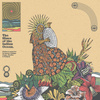
Recorded in 2018 on Mauritius and Rodrigues islands at artists’ houses, in the parks, on the beach, by the fire. Enjoy the islands ambience sounds in the background!
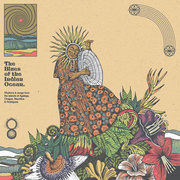
Sound recordings by Luka Kumor, mastering by Rashad Becker, album art hand drawn by @ventralisgolden.
THE BLUES OF THE INDIAN OCEAN / Rhythms and songs from the islands of Agalega, Chagos, Mauritius and Rodrigues
At the end of the 19th century, the anti-slavery activist and poet Charlotte Forten heard a number of songs sung by slaves from the African American community in South Carolina. Trying to put her experience into words, she noted that the songs “can’t be sung without a full heart and a troubled spirit”. The very same circumstances that inspired blues songwriters in North America also shaped early sega music on the islands of the Indian Ocean. Although slavery was abolished, dues have never been fully paid; its consequences persist to the present day, and above all, the affected people were never given enough voice, respect and recognition. Although the history of the African diaspora in this region is more complex than its counterpart in the Atlantic Ocean, the marginalisation of its people was on a par.
In the atrocious situation in which they found themselves, creativity became a means of survival. Secret music gatherings in the woods were a rare occasion to freely express emotions, to feel accepted and to regain dignity. The cathartic potential of these hidden sessions, and of sega music itself, supported the psychological, spiritual and social integrity of the uprooted people and – as a consequence – sparked an independence movement. Until the second half of the 20th century, these self-empowering practices were forbidden and repressed by the colonial machinery of human deprivation and – for the very same political reasons – were simply described as evil by the Catholic church, the spiritual force of colonialism in this part of the globe.
The islands of the Indian Ocean witnessed a rapid and chaotic mixing of cultures: Africans kidnapped from different regions of the continent, the indentured labourers from Africa and India and settlers from the Middle East and China. The infinite creativity of humans confronted with the hardship of colonial capitalist reality gave rise to a new form of music that – just like creole language – had not existed before. New instruments were created: the ravann – a form of frame drum, and the maravann – a shaken idiophone made of cane flower stems (originally iron plates) filled with small stones or canna seeds. To add a high-pitched sound, the sugarcane field workers hit their machetes or tapped a bottle with a coin, which has mostly been replaced by the triangle these days. The jerican (creole for ‘jerrycan’) also served as an improvised, widely available supplement to the rhythm section. On the isolated island of Rodrigues, the drumming is complemented by DIY instruments: mayos –two flat pieces of wood for clapping, and tin – two tuna cans scraped against each other.
Just like blues music, the Indian Ocean sega also developed over time. Closely related to the resistance movement, it soon became mainstream. Sega singers began to sing about day-to-day life, its joys and sorrows, and of course also about love. From the 1960s onwards, sega music became mostly entertainment, purged of the deep therapeutic potential that had been its core element until then. Independence finally came, but many marginalised black communities – such as the Chagossians evicted from the Diego Garcia atoll by the British military – struggled in the suburbs of Porlwi (creole for Port Louis) and other cities on Mauritius. This original form of sega music, carried forward by charismatic figures like Ti Frere, Fan Fan or Josianne Cassambo-Nankoo, is now thriving again in response to the challenges of the modern world. This society that never healed its wounds is now saddled with inequality, alienation, violence and drug problems. But sega is far from a museum artefact irrelevant to the current generation. New groups are being formed, lyrics are expressing the issues of the present day, and a new generation of musicians is reworking the genre. You can see examples of this at jujusounds.com – vibrant house parties, festivals, new album releases, cultural work with children, and multigenerational family groups playing sega together. The culture is relevant and alive.
The relatively long distances separating the islands led to the diverse evolution of the genre in different locations. The populations of the Agalega and Chagos islands gathered on secluded beaches after long days of work on the plantations. Their segas are long and slow in tempo – only as fast as dancing barefoot on the fine coral sand allows. The songs unveil deep emotions and the lyrics are very poetic. The Chagossians sing about the traumatic experience of eviction from the Diego Garcia atoll just after it became a British territory as part of the Mauritius independence deal. Soon after, the atoll was leased to the US, who needed a military base in that area to fight wars in the Persian Gulf and to enable their military involvement in the entire Middle Eastern region. The Group Tanbour Chagos is actively involved in the political struggle to reclaim the archipelago – a case that has gained recognition and support from the United Nations. Renouvellement Agalega represent a tight-knit community who, due to economic reasons, left their isolated home island and settled on the outskirts of Port Louis. This community may grow in number very soon as Mauritius is currently negotiating a deal over the Indian military presence on Agalega which threatens the habitation of the 300 people who have remained there. The recording session took place on the beach at night. The crackling fire, the lazy ocean swell breaking on the beach, the chatter of the kids – this recording reflects the true community spirit of sega culture.
Abaim is a unique project. Apart from playing beautiful, hypnotic segas, the group has been actively involved in cultural and educational work with marginalised communities on the main island of Mauritius since the early 1980s. To ensure the culture is alive and meaningful, Abaim decided to work with children, specifically those from families affected by inequality, poverty, and all the other associated problems. The Abaim community centre in Beau Bassin is home to countless initiatives and workshops related to creole music and language. The founders are truly dedicated to their mission to maintain the deeply therapeutic aspect of sega music. They focus on and carry forward the empowering, community-building potential of the musical culture that has been lost in the popular, mainstream sega. Get to know more about Abaim and watch an inspiring interview with one of its founders, Alain Muneean here: youtu.be/COAMk2gvVlk
Zeneration Cassambo is a well-recognised family group from Mauritius that has been performing for generations. The session took place in the garden of the very same house where the group Zenfan Ti Riviere and famous vocalist Josianne Cassambo-Nankoo delivered ecstatic sega nights at the beginning of the 1980s. Nowadays, super-tight segas, charged with emotion, are played by the grandchildren of Josianne on the same red-painted courtyard dancefloor. JuJu Sounds also had the honour of participating in Josianne’s 79th birthday party – you can check out the recordings from this vibrant sega night on our website.
Sega Tambour from the island of Rodrigues is without a doubt the fastest style of music played by the African diaspora in the region. Cut off in the middle of the ocean, Rodrigues is home to a unique style of sega. The frenetic rhythms pounded on the tambour frame drum, clapped on mayos and played on the tin and triyang (creole for ‘triangle’), accompanied by dynamic vocals, set this style apart from Sega Tipic. There is no shaking sound of the maravann here; most instruments are very simple and – with the exception of the tambour – are made by the musicians themselves. This sega is at a different stage – the old master musicians are still alive and active, but the young have not yet joined. Sega parties on Rodrigues are not only about dancing, but also about solving community issues and personal conflicts at the same time – just as rap battles allow participants to sing out all their grievances while facing their adversary. This art is open to everyone, irrespective of age, gender or status, which has led to some unique talents surfacing. The Sega Tambour “All Stars” agreed to record with us and are proudly presented on this compilation. Read more about Sega Tambour from Rodrigues island on jujusounds.com in the full story dedicated to this unique place and culture.
Recorded by JuJu Sounds
Mix by Michał Kupicz
Mastering by Rashad Becker
Text by Luka Kumor / JuJu Sounds
Graphic & layout by @ventralisgolden
Special thanks to Abaim for their work, support and for making it all the way to Poland in the summer of 2024 to share sega tipik live!

Dodatkowe informacje strefa 3












Rejestracja
Jeżeli wcześniej nie założyłeś konta w naszym sklepie, zostaniesz poproszony o podanie swoich danych i adresu dostawy.
Załóż nowe konto



Nie pamiętasz loginu lub hasła?
Na Twój adres zostanie wysłany e-mail, który pozwala na automatyczne zalogowanie się. Zmiana hasła będzie możliwa po zalogowaniu na stronie edycji Twoich danych.

